
 English (United Kingdom)
 Български (България)
 বাংলা (বাংলাদেশ)
 Bosanski (Bosna i Hercegovina)
 Čeština (Česko)
 Dansk (Danmark)
 Deutsch (Deutschland)
 Ελληνικά (Ελλάδα)
 Español (España)
 Eesti (Eesti)
 Suomi (Suomi)
 Français (France)
 Gaeilge (Éire)
 हिन्दी (भारत)
 Hrvatski (Hrvatska)
 Magyar (Magyarország)
 Bahasa Indonesia (Indonesia)
 Íslenska (Ísland)
 Italiano (Italia)
 日本語 (日本)
 ქართული (საქართველო)
 Lietuvių (Lietuva)
 Latviešu (Latvija)
 Македонски (Северна Македонија)
 Bahasa Melayu (Malaysia)
 Nederlands (Nederland)
 Norsk (Norge)
 Polski (Polska)
 Português (Portugal)
 Română (România)
 Slovenčina (Slovensko)
 Slovenščina (Slovenija)
 Shqip (Shqipëri)
 Srpski (Srbija)
 Svenska (Sverige)
 Kiswahili (Kenya)
 ไทย (ไทย)
 Filipino (Pilipinas)
 Türkçe (Türkiye)
 Tiếng Việt (Việt Nam)
Chicken Pirate Route (Turbo Games) – mini-game review for players from Malaysia
Chicken Pirate Route Review: Theme and Atmosphere
Chicken Pirate Route is a pirate mini-game with step-by-step multipliers, released by Turbo Games on May 18, 2026. It is based on the licensed CrossyRun™ mechanic with one significant addition: instead of the usual one-square step, the pirate chicken rolls a die and moves 1–6 positions in one turn. The player doesn't spin reels or collect lines — they guide the hero along a chain of rafts and boats to the Golden Island, where the round's largest multiplier is hidden. The closer to the finish, the higher the potential multiplier and the higher the chance of falling into the water to sharks and octopuses.
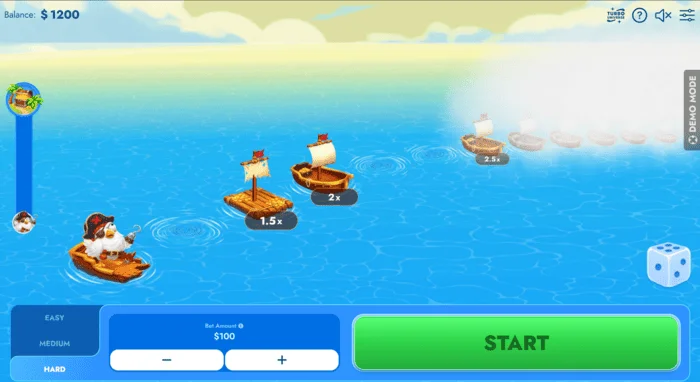
The action takes place not on a busy highway, as in most "chicken" instant games, but on the open sea with coastal shallows. The route is made up of wooden rafts, dinghies, and empty water gaps, between which the chicken in a tricorn hat jumps. The graphics are cartoony, with an emphasis on characters and large ship silhouettes; the soundtrack is a light pirate motif with an acoustic guitar and the sound of waves, without aggressive electronic background. Each landing on a raft is accompanied by a landing sound, each miss – a splash of water and a short comical end to the round. The theme is not "glued" on for aesthetics – it directly explains the game's logic: open sea = risk, chain of rafts = safe steps, island with a treasure chest = maximum potential.
The base RTP of Chicken Pirate Route is 96%, which is considered a good indicator for an instant game from the provider Turbo Games. The volatility here is adjustable – it is determined by the player's chosen difficulty level, not a rigid mathematical model. The betting range is from 0.50 MYR to 460.00 MYR per round; the absolute payout cap is limited to $10,000, even if the multiplier is formally capable of going higher. The game is built on HTML5, the client size is 28.1 MB, no separate installer is needed: it runs in a browser on desktop, smartphone, or tablet, in portrait and landscape orientation.
The main thing that distinguishes the game from similar releases in the genre is the combination of three elements at once: a visible route (the player knows in advance where the raft is and where the fall is), a die with a 1–6 step (the length of the next jump cannot be predicted), and three separate difficulty modes with different maximums and starting multipliers. On the easy level, a round almost always gives a small multiplier, on the hard level – long series of "dummy" runs are interrupted by rare but explosive multipliers reaching tens of thousands of the bet. Because of this, the pirate route feels good both in short sessions of 10–20 rounds and in long sessions of 200+ rolls, where the interest is not so much in a single hit as in the entire arc of the distance in the selected mode.
How Chicken Pirate Route Works: Die, Route, and Cash Out
The main game mechanic is step-by-step multipliers on the route, controlled by a die roll. There are no Free Spins, Wilds, or Scatters in the usual slot sense; the place of classic bonus rounds is taken by a combination of three things: difficulty mode, a 1–6 step die roll, and the Cash Out button. Each element affects the rhythm and potential earnings of a single round; together, they form the very "game against the water" for which the release was made.
Three Difficulty Levels — Easy, Medium, Hard
Before the round starts, the player chooses not only their budget but also one of three difficulty modes. The modes differ in both the starting minimum multiplier (the one available immediately after the first successful step) and the multiplier ceiling at the final position of the route:
| Mode | Minimum Cash Out | Maximum Multiplier |
|---|---|---|
| Easy | 1.03x | 24x |
| Medium | 1.15x | 2500x |
| Hard | 1.5x | 72000x |
On Easy, the route is dense — there are few empty water gaps, and multipliers grow slowly. This is a warm-up mode: even a long series of dozens of rolls rarely yields a serious profit, but the bankroll also depletes slower. Medium is a compromise mode: there are significantly fewer rafts, the chance of failure on each roll is higher, but multipliers halfway through the route already exceed 10x, and at the end, reach 2500x. Hard is the mode for hunting big wins: water takes up most of the path, safe rafts are few, and each continuation of the round becomes a conscious risk against probability. It is on Hard that the x72000 multiplier lives, for which the title is included in selections of "instant games with potential". However, the actual payout is limited by a $10,000 cap: if the bet is large, the multiplier ceiling in the real wallet will be less than the formal maximum.
Die Roll — Advancing 1–6 Steps
After selecting the mode and amount, the player presses the roll button. The die value from 1 to 6 is displayed on the screen, and the pirate chicken advances exactly that many positions along the route. There are no "two dice" or hidden math here: one value = one jump. If the position where the chicken lands turns out to be a raft or a dinghy, the round continues, and the current multiplier becomes available for collection. If the landing hits empty water, the round ends instantly, the money is lost, a short animation with a shark or octopus appears, and the game offers to start the next round.
The main feature of this mechanic is the visibility of the route. The player knows in advance where the raft is and where the empty water is, even before rolling the die. This changes the game's psychology: after a good roll of 5-6 steps forward, it's sometimes clear that the next three positions are consecutive failures, and continuing the round almost guarantees a loss. The decision to "take it now or roll again" is not blind here, but based on the visible picture – this is why Chicken Pirate Route is praised: there's no feeling of "luck or not," there's a feeling of "assessed the risk and made a decision."
Cash Out — Collect the Multiplier at Any Time
After each safe landing, the current multiplier is displayed on the screen and the Cash Out button is activated. Upon pressing, the amount is multiplied by this multiplier, the winnings are credited to the balance, and the round ends. The alternative is to roll the dice again and try to go further, increasing the multiplier. The size of the multiplier increase between two adjacent rafts depends on the difficulty mode and the current position in the route; on Hard, the increase can double the multiplier in one step, on Easy — add fractions of a unit. There are no "partial cash-outs" (take part, leave part in play) — Cash Out always takes the entire current multiplier and closes the round.
It is from the combination of "visible route + random roll + voluntary Cash Out" that all the interest arises. In Hard mode, you can accumulate 30x in five rolls, see one raft and three empty cells in a row ahead on the route, understand that a 6 on the die will land the hero in the water, and collect the multiplier — precisely because the route map has already been "read". Or you can stay, hope for a 1 or 2 in the roll, land on that single raft, reach 80x, and then decide again — to collect or to continue to the island.
Provably Fair — Verifiable Fairness of Each Round
Chicken Pirate Route is built on the Provably Fair algorithm, which has become a hallmark of Turbo Games. The result of each die roll is determined not by a "black box" server, but by a cryptographic link of three elements: a server seed, a client seed, and a nonce counter. After the round ends, the player can open a technical tab in the betting history and verify that the actual die outcome matches what was calculated by this link. This is not an empty declaration – it is a concrete, verifiable method to ensure that the result was generated before the roll and not manipulated during the game.
Practically, Provably Fair does not change the odds — it doesn't make the round "fairer" in terms of greater frequency of large multipliers, nor does it make Hard mode more profitable. What it does is resolve the argument about "the casino rigged it." If a roll produced a six and landed the chicken in the water, it can be re-verified, not dismissed as "randomness." For players accustomed to classic slots with a closed RNG, such transparency is a significant step forward: no review site can mathematically disprove your roll if the calculations align.
Technical Parameters of Chicken Pirate Route
| Provider | Turbo Games |
| Country | Malaysia |
| Release Date | May 18, 2026 |
| Game Type | Step-multiplier mini-game |
| Mechanics | CrossyRun + dice-progression |
| Theme | Pirates, open sea, Golden Island |
| RTP | 96% |
| Volatility | Adjustable (depends on difficulty mode) |
| Difficulty Levels | Easy / Medium / Hard |
| Maximum Multiplier | x72000 (Hard) |
| Payout Cap | 10000 USD per round |
| Minimum Bet | 0.50 MYR |
| Maximum Bet | 460.00 MYR |
| Dice Step Range | 1–6 positions per roll |
| Wild Symbol | No (reel-less mechanic) |
| Scatter Symbol | No |
| Free Spins | No |
| Feature Buy | No |
| Jackpot | No |
| Provably Fair | Yes, verifiable seeds |
| Technology | JS, HTML5 |
| Client Size | 28.1 MB |
| Orientation | Portrait and Landscape |
Route Objects and Game Visual Language
Since the game does not use classic reels and a paytable with x3/x4/x5, the usual paytable here is replaced by a list of route objects. Several types of elements are visible on the screen simultaneously: safe landing spots, dangerous pitfalls, and the final point of the route. Each object plays a specific role in the round, and how quickly the player learns to read them from the screen determines whether they will collect the multiplier in time or fall into the water.
Route Objects
| Object | Function | Description |
|---|---|---|
| Boat | Safe Spot | The main type of "island" on the route. Upon landing on a boat, the round continues, and the current multiplier becomes available for Cash Out. |
| Raft | Safe Spot | An alternative version of a safe step, more common closer to the beginning of the route. Functionally identical to a boat. |
| Empty Water | Round Loss | If a die roll lands the chicken on this section, the round ends instantly, money is lost. Visible on the route in advance. |
| Shark / Octopus | Loss Animation | Appears when falling into empty water. Does not affect the round outcome — it is a visual representation of a loss, without a separate mechanic. |
| Coin Chest | Multiplier Visual Marker | A chest with a number is drawn above each safe spot — the current multiplier for that position. The further along the route, the larger the chest. |
| Golden Island | Route Final | The final point where the maximum multiplier of the mode is located (24x / 2500x / 72000x for Easy / Medium / Hard). |
| Pirate Chicken | Player Avatar | The main character in a tricorn hat. Moves along the route 1–6 steps per die roll. Cosmetic skin selection may be present depending on the casino, but does not affect the math itself. |
| Dice | Step Generator | Standard six-sided die. Each value from 1 to 6 is equally probable, the outcome is determined by the Provably Fair algorithm from a combination of server and client seeds. |
Color Palette and Graphics
The art design is crafted in vibrant marine tones: turquoise water, golden sand of the Island, dark brown boats and rafts, white sails with skulls. The pirate chicken is drawn large, with a prominent tricorn hat and scarf, so that the figure is legible even on a smartphone screen in portrait orientation. Animations are short: a die roll takes about a second, the hero's jump - another second, so one round with an average budget lasts 30-60 seconds with active play and 90-120 seconds if the player ponders each Cash Out. No "long intro scenes" for bonus rounds or hidden mini-games between rolls - Chicken Pirate Route deliberately maintains a rhythm of one step under half a minute, so the pace doesn't drop.
Sound and Effects
The soundtrack is a light pirate motif with acoustic guitar and background wave sounds. There are no loud crashes, drum sections, or club background; this is a conscious decision by Turbo Games, because Chicken Pirate Route is designed for long sessions with decision-making, not short emotional bursts. Each die roll is accompanied by a short sound, each landing on a boat by a faint thud, and a fall into the water by a splash and a comical "cluck." If playing with sound, the atmosphere is created; if without, the game logic is still fully legible on the screen; no information is conveyed through sound.
Our Experience: How to Play Chicken Pirate Route
We played approximately 400 rounds of the game in demo mode, dividing the session into three blocks of 130–140 rolls for each difficulty mode, and gathered several practical conclusions. The variance here differs greatly between modes: on Easy, the session is smooth, without large jumps; on Hard, long series of zero rounds are interspersed with rare but significant payouts. The main thing is not to try to play Hard the same way you play Easy: it’s not "the same mode, just with bigger numbers," it’s a different style of risk management.
- Bankroll — plan for a minimum of 100 rounds of your chosen bet on Easy and Medium, and a minimum of 200–300 rounds on Hard. In Hard mode, the first 50 rounds can easily be completely "dry" without a single large multiplier — this is normal variance, not a "bad streak." If you are playing at the top bets closer to 460.00 MYR, it's better to have a reserve for 500 rounds: single failures at such a bet are more painful in absolute terms, and hasty attempts to "rebound" usually worsen the drawdown.
- Choosing a mode for your goal — Easy is suitable for warming up and for wagering bonuses: the return rate is stable, and the session doesn't "fly" to zero in a dozen rounds. Medium is for main sessions when you want to stay awake and not go broke: multipliers are already tangible, and the risk of failure is moderate. Hard is only for short hunting expeditions with a pre-accepted readiness to lose the entire budget for a large multiplier. Jumping straight into Hard as soon as you start the game, in our experience, is the most common beginner's mistake.
- When to press Cash Out — carefully observe the route ahead. If you see 3–4 empty cells in a row beyond the current boat, the chance of a safe jump drops sharply: a roll of 1, 2, or 3 will almost certainly land you in the water. In such a situation, take the multiplier, even if it feels like "you can push a little further." In our observations, attempts to "squeeze" in such a position ended in failure in approximately three out of four cases. However, if you see a chain of 2–3 rafts in a row ahead — continuing the roll makes sense, especially in Medium mode.
- Frequency of hitting a large multiplier — in Hard mode, over 130 rolls, we reached a position with a multiplier above 100x exactly once. This is consistent with the logic of high volatility: large multipliers here are rare outliers, and you shouldn't base your main bankroll on them. We never reached the Golden Island on Hard in 400 rounds — this is normal; mathematically, the x72000 ceiling is a reference point, not an average result. Most "successful" Hard rounds closed at 5x–20x with a Cash Out before the critical zone.
- What DOESN’T work — trying to "guess" the dice based on previous rolls. The Provably Fair algorithm generates each value independently of past ones, and a series of four consecutive sixes does not make a five more likely. In our testing, we specifically checked: after 5 consecutive sixes (there was such a block), the next 6 rolls were distributed absolutely evenly — no "equalization." Systems like "after a long drought, a big one is sure to come" don’t work here.
- Game speed — the standard pace allows about 10–15 seconds per roll, which lets you scout the route ahead. If you enable "fast" mode (if the casino supports it), one roll takes 2–3 seconds, and conscious decisions become almost impossible — the game turns into pure luck. For a distance of 200+ rounds, normal mode gives significantly more chances to profit than accelerated mode.
- When to stop — after a large multiplier (50x and above on Medium, 200x and above on Hard), it makes sense to take a 5–10 minute break or even exit the session altogether. In our observations, attempting to immediately "repeat" a large win in three out of four cases resulted in the failure of the next 15–25 rounds and consumed the recently won profit. This is not a mathematical law, but empirically, the pattern played out consistently.
- Demo and real play — the mathematical model in demo and real mode is identical: the same 96% RTP, the same dice, the same Provably Fair verification. If someone tells you that "sixes appear more often in demo" or "real mode is tougher" — this is a myth; no different versions of Chicken Pirate Route exist.
Where to Play Chicken Pirate Route
The game is built on HTML5 and runs equally well on desktop, iPhone, and Android — no separate client is needed, everything works directly in the browser. The asset size is about 28.1 MB; the first launch may take 5–10 seconds on slow mobile internet, subsequent launches are almost instant due to caching. On smartphones, the dice roll button and the Cash Out button are located at the bottom of the screen to enable thumb tapping when held with one hand; the route with boats automatically redraws itself for the selected orientation — portrait or landscape.
The graphics are adapted for different screen sizes: on iPads and large Android tablets, a wide landscape scene with a long route to Golden Island opens up; on compact smartphones, the scene shrinks, but key objects — the current position, the nearest 4–5 rafts, and the multiplier counter — remain large and readable. Animations maintain 60 fps even on mid-range Android smartphones from previous generations; we observed no lag on flagships. Traffic after loading is minimal — about 30–50 KB per round (dice value + result), which is important for mobile internet and playing on the go.
Strengths and Weaknesses of Chicken Pirate Route
Advantages
- Three full difficulty modes — Easy, Medium, Hard — with different multiplier ceilings (24x / 2500x / 72000x). The same title covers both casual sessions and hunting for big wins — without the need to switch to another release.
- Rolling a die for 1–6 steps instead of the usual single step — this is a rare solution for the genre, which adds variability and makes each round unique.
- Visible route ahead — the player makes Cash Out decisions not blindly, but based on the actual picture. This turns the game into meaningful risk management, not just a button press.
- Provably Fair with the ability to character-by-character verify the outcome of the roll. Any round can be re-checked using server and client seeds — disputes with the casino about "rigging" are technically impossible.
- Betting range from 0.50 MYR to 460.00 MYR — comfortable for both wagering bonuses at minimum bet and for a large bankroll aiming for the upper ceiling.
- HTML5 and mobile adaptation — portrait and landscape orientation, buttons in thumb zones, legibility on compact screens. Play on the go without desktop connection.
- Art design and pirate theme are presented neatly — without over-effects, without aggressive electronic soundtrack, with a calm marine background, comfortable for long sessions.
Disadvantages
- Strict payout cap of $10,000 per round — even if the multiplier formally reaches x72000, the actual winnings are always limited to this amount. On large bets close to 460.00 MYR, the cap is felt even at significantly smaller multipliers.
- No Free Spins, Wild, Scatter, or Feature Buy — the game deliberately opted out of the classic slot set. Those who enjoy long bonus rounds with growing multipliers may find Chicken Pirate Route dry.
- High variance on Hard — series of 30–50 empty rounds in this mode are normal, and without a bankroll of 200–300 bets, entering Hard makes no sense.
- Information about hit frequency and exact dice weights is not disclosed by the provider — the probability of each option has to be estimated empirically, through personal sessions.
- There is no social component (ratings, chats, observing other players' bets) within the game — it's a solo title "one-on-one with the route."
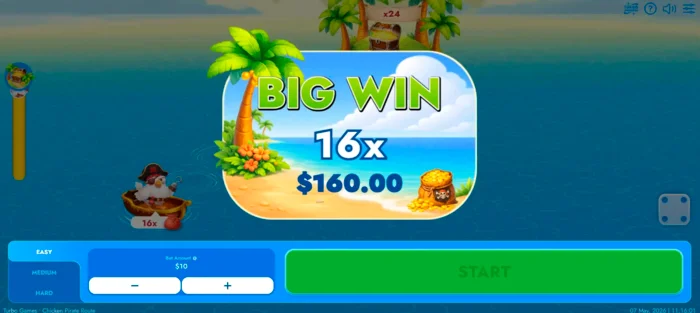
Chicken Pirate Route Game Screenshots
Is Chicken Pirate Route Worth Playing?
Chicken Pirate Route is a carefully crafted instant game for those who are tired of classic slots and want meaningful risk management instead of "click and see." It doesn't try to compete with prominent 5×3 releases in visual density or the number of bonus rounds; instead, Turbo Games focused on a simple, yet deep cycle of "roll - assess route - Cash Out decision" and refined it to a state where playing is enjoyable for both five minutes and an hour and a half straight. The pirate theme doesn't feel "pasted on" — it directly explains the logic of the route, and Golden Island as the final goal works much more understandably than an abstract "bonus round" in a regular slot.
Chicken Pirate Route is suitable for: players who enjoy instant formats with quick rounds of 30–60 seconds; those who value Provably Fair and want to see verifiable numbers behind every result; anyone interested in the decision-making process of "collect or continue" — and not just the final winnings. For a long session on Medium mode, the game behaves steadily enough not to burn through the bankroll in half an hour, and dynamically enough to keep it engaging.
Chicken Pirate Route is not suitable for: fans of classic 5×3 slots with long bonus rounds, accumulating multipliers, and Feature Buy — these are deliberately absent here. It's also not suitable for those who prioritize a high payout ceiling in absolute terms: the $10,000 cap strictly limits the upper end of the distribution. Players who enjoy complex, multi-layered mechanics with dozens of symbols and combinations may find Chicken Pirate Route minimalistic — but this very minimalism is its strength.
What makes the release remarkable is the combination of three elements in one game: the licensed CrossyRun mechanic, original dice-progression, and three full difficulty modes with a real difference in risk and ceiling. Most "chicken" instant games limit themselves to one of the three; here, all three are combined in one title, and this is its "own voice" for which Chicken Pirate Route is worth launching instead of another genre clone.
In short: bet 0.50 MYR–460.00 MYR, choose your mode, roll the dice, and decide when to collect the multiplier — Chicken Pirate Route is purely about this cycle, with no claims for more.
Frequently Asked Questions about Chicken Pirate Route
Can I play Chicken Pirate Route for free?
Yes, you can launch the demo directly on our page without deposit or registration.
What is the RTP of Chicken Pirate Route?
The base RTP is 96%, which is considered a good indicator for an instant game from Turbo Games. Volatility is adjustable and depends on the chosen difficulty mode.
What is the maximum winnings in Chicken Pirate Route?
The maximum multiplier is x72000 of the bet in Hard mode, but the absolute payout cap is limited to $10,000 per round.
How many difficulty levels are in Chicken Pirate Route?
Three levels — Easy with a 24x cap, Medium with a 2500x cap, and Hard with a 72000x cap. Each mode offers its own balance of risk and maximum multiplier.
How does the dice mechanic work in Chicken Pirate Route?
Each roll gives a value from 1 to 6, and the pirate chicken advances exactly that many steps along the route of boats and rafts. Landing on a safe spot — the round continues, landing in empty water — the round is lost.
Is Chicken Pirate Route available in Malaysia?
Yes, Chicken Pirate Route is available to players from Malaysia. The demo version can be launched directly on this page without registration.
What is the betting range in Chicken Pirate Route?
The betting range in Chicken Pirate Route is from 0.50 MYR to 460.00 MYR. Suitable for both short sessions and large bankrolls.
Are there free spins or Feature Buy in Chicken Pirate Route?
No, there are no classic Free Spins or Feature Buy in the game — Chicken Pirate Route is built on step-by-step multipliers with a die roll, without a separate bonus round.
How does Provably Fair work in Chicken Pirate Route?
This is a system for verifying the fairness of a round: after a roll, you can open a technical tab and compare the result with a cryptographic link of server and client seeds. Any dice outcome can be mathematically verified.
What is the jackpot in Chicken Pirate Route?
There is no separate jackpot in Chicken Pirate Route — the upper end of payouts is formed through the maximum Hard mode multiplier (x72000) with a $10,000 cap per round.
What devices can I play Chicken Pirate Route on?
Desktop, iOS, and Android. The game is built on HTML5, no separate client is needed, and both portrait and landscape orientation are supported.
What is the volatility of Chicken Pirate Route?
Volatility is adjustable — the player chooses it through the difficulty mode. Easy — calm pace, Medium — medium variance, Hard — high volatility with long dry spells and rare large multipliers.